
Article content
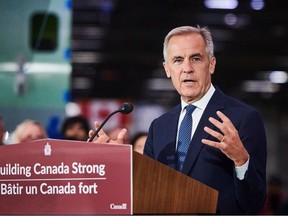
Prime Minister Mark Carney was right to kill his government’s mandate that 20% of all new car sales in Canada had to be zero emissions vehicles starting next year – current sales are less than half that – but that’s just the tip of the iceberg of the problem.
Advertisement 2

Article content
The bigger problem is that, according to the Parliamentary Budget Office, Canada’s federal and provincial governments – mainly Ontario and Quebec – have earmarked up to $52.5 billion to subsidize 13 major Electric Vehicle supply chain projects, 14% more than the $46.1 billion the EV industry in Canada is spending on itself.
Article content
Article content
While most of these subsidies have yet to be paid, these governments have a huge financial stake of taxpayers’ money in the eventual success of the EV industry, with some projects already delayed because of lower-than-expected EV sales due to higher costs to consumers compared to internal combustion engine vehicles, a shortage of public charging stations and reduced range in cold weather.

Your Midday Sun
Article content
Advertisement 3
Article content
U.S. President Donald Trump’s tariffs have further decreased sales of EVs and the U.S. is abandoning subsidies to the American EV sector approved by his predecessor, Joe Biden, throwing the future of Canada’s EV industry into doubt.
Carney could boost EV sales by restoring federal subsidies to EV buyers of up to $5,000 for qualifying vehicles, which the Liberals suspended earlier this year.
They’ve promised to re-introduce them – a textbook example of the government subsidizing an unpopular product, thus throwing good money after bad.
Read More
-

Canada to stall electric vehicle rules as Carney seeks to boost auto sector
-

Poilievre accuses PM of flip-flopping on gas, diesel car ban
-

ELBOWS DOWN: Carney sees popularity drop, Tories still leading Liberals


Advertisement 4
Article content
When Carney announced his decision to cancel the 20% mandate for new EV sales in 2026 on Friday, he said the government will conduct a 60-day review of future mandates of 60% of new car sales being EVs by 2030 and 100% by 2035.
He said this will “consider potential amendments to the annual sales targets,” as well as “explore possible additional flexibilities” to ensure government programs promoting EV sales “reflect market realities, remain effective for Canadians” and do not “place undue burden on automakers.”
Aside from responding to the public’s declining interest in EVs in a time of economic uncertainty, rising unemployment and cost-of-living concerns, Carney is responding to warnings from the auto sector that its unrealistic EV mandates would further damage Canada’s struggling auto sector, which employs almost 550,000 Canadians in direct and indirect jobs.
Advertisement 5
Article content
Carney’s cancellation of the consumer carbon tax and his postponement of the 2026 EV mandate – both Justin Trudeau-era policies – while welcome, are baby steps compared to what really needs to be done.
They are only two of more than 140 federal government programs, administered by 13 federal departments and agencies, that as of 2023 had committed more than $200 billion of taxpayers’ money to address climate change.
Independent evaluations – for example, by the federal environment commissioner and PBO – have concluded they will fall far short of achieving Canada’s target of reducing industrial greenhouse gas emissions to at least 40% below 2005 levels by 2030 and net zero by 2050.
RECOMMENDED VIDEO

We apologize, but this video has failed to load.
According to the latest government data from 2023, emissions were down only 8.5%.
Advertisement 6
Article content
The problem with these unrealistic federal targets is that they lead to unattainable and costly policies, such as the now-cancelled mandate that EVs had to reach 20% of all new car sales by next year.
A report by federal environment commissioner Jerry DeMarco following an audit of the Liberals’ Net Zero Emissions Accountability Act last year concluded the government’s lack of transparency made it impossible for the average citizen to understand, much less believe, its claim it will reduce Canada’s emissions by at least 40% below 2005 levels by 2030.
In examining a sampling of 20 government measures to reduce emissions, it found only nine were on track to achieve their goals.
Of 32 additional measures the government claimed would help boost reductions from 36.2% to at least 40% in 2030, only seven were new.
Advertisement 7
Article content
An investigation last year by Auditor General Karen Hogan of the now-disbanded, $1-billion Sustainable Development Technology Fund, which audited a sampling of the projects it funded, found 90 cases where conflict-of-interest rules were not followed in awarding $76 million worth of government contracts and 10 examples where $56 million was awarded to ineligible projects.
It’s not just the Liberal government’s EV mandates that needs to be critically assessed. So does its entire $200-billion program to address climate change.
Carney has taken a small step in the right direction by cancelling the EV sales mandate for next year but if that’s where it ends, it won’t save taxpayers from a looming financial disaster.
lgoldstein@postmedia.com
Article content
