
Author of the article:

Published Sep 22, 2025 • 4 minute read
Article content
Fall has arrived.
Advertisement 2

Article content
That means days are getting shorter, the weather is turning cooler, and winter is – gasp – on the horizon. The season will officially begin Monday at 2:19 p.m. Eastern time, the exact moment of the autumnal equinox.
Article content
Article content
On Monday, the sun will rise due east and set perfectly in the west. The sun’s most direct rays will have crossed into the Southern Hemisphere. South America, much of Africa and Australia are on their way to brighter days and summertime. The Northern Hemisphere will experience the opposite.
The equinox also brings approximate equal daylight and darkness to every place on Earth, with most people experiencing a little over 12 hours of daylight.
The next three months will also represent a transitional period in the atmosphere. The polar vortex will begin to grow, the jet stream will dive southward over the contiguous United States and the weather will be more turbulent. As this season begins, large-scale storm systems will soon roll across the nation’s heartland, whipping about strong winds, severe weather and, eventually, winter storms and blizzards.

Your Midday Sun
Article content
Advertisement 3
Article content
Dropping daylight
The fall equinox also features the most dramatic reductions in daylight.
Washington, D.C., for example, will begin to lose 2 minutes 30 seconds of daylight every day. Boston’s days are growing shorter by 2 minutes 49 seconds each day, while Miami is losing a little under a minute and a half daily. The effect is more dramatic closer to the poles – that’s why the northern U.S. sees a steeper drop-off in day length compared with southern states.
In October, for example, places such as South Florida and the Texas-Mexico border will lose about 40 minutes of day length by the end of the month. But for the Northern Tier, northern New England and the Pacific Northwest, that daylight decrease is closer to 90 minutes.
Advertisement 4
Article content
Changes in day length stem from Earth’s tilt on its axis. The planet leans about 23.5 degrees. In June, the Northern Hemisphere leans toward the sun – hence the longer days, more direct sunlight and warmer weather. In the wintertime, we lean away from the sun.
The equinoxes represent the fleeting moment in between extremes, when neither the Northern nor Southern Hemisphere is preferentially leaning toward the sun. That’s why everybody gets the same amount of sunlight and night on Monday; the term equinox literally translates to “equal night” in Latin.
The changing leaves
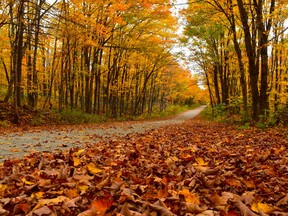
Around this time of year, you might also notice the leaves changing colour. The waning sunlight cuts back on the leaves’ ability to generate food, and will ultimately lead to the change in colour.
Advertisement 5
Article content
Leaves have a sugary diet; plants produce glucose to feed on. They use glucose as energy for respiration – breathing in carbon dioxide and exhaling oxygen.
Creating glucose can take a lot of time, but sunlight speeds up the chemical reaction. To capture sunlight and snag the energy associated with it, leaves are covered with chlorophyll, which is a remarkably effective at absorbing sunlight.
Chlorophyll isn’t the only chemical residing inside a leaf. The rest of the chemicals are apparent in fall, when the plant’s food engine shuts down.
Carotenoid is responsible for the yellow, orange and brown colours in vegetables, whereas anthocyanin creates the red colour present in many fruits. These chemicals are in all plants, but are generally overpowered by the green chlorophyll.
Advertisement 6
Article content
The subdued colours can emerge from their hiding every so often, only when the chlorophyll disappears for the season.
Temperature has little effect on the shade of leaves; instead, it all comes down to the amount of sunlight. When fall arrives and the amount of daylight wanes, photosynthesis comes to a halt and chlorophyll dwindles. This allows us to see the other colours layered beneath.
The scent of the season
When the leaves fall, they die. As they take their last breath, they exhale all sorts of gases through tiny holes known as stomata. Among these compounds released are terpene and isoprenoids, common ingredients in the oils that coat plants. Terpenes are hydrocarbons, meaning their main ingredients are hydrogen and carbon. Pinene, a species of terpene, smells like – you guessed it – pine. It’s a main ingredient to the saplike resin that repairs the bark of conifers and pine trees.
Advertisement 7
Article content
Occasionally, these gas molecules excreted by plants – known as volatile organic compounds – interact with variants of nitrous oxide. This can lead to ozone production, which can smell a bit like chlorine – or the exhaust of a dryer vent.
In addition to the release of gases contained within dying vegetation, two other effects contribute to the emotion-evoking scent that accompanies a northwest autumn breeze: decomposing plant matter, and pollutants trapped at the ground levels during the fall months.
The soil in most parts of the world is rich in Geotrichum candidum, a fungus that causes rotting and decomposition of fruits and vegetables and dense plant matter. In fact, Geotrichum candidum has been sampled on all seven continents. This is just one of many species that erode away as deceased organisms, the chemical reactions of which contribute to the smell of fall.
Article content
