
While Trudeau was boasting about strong economic growth, average Canadian’s standard of living was plummeting
Article content
A new report by the Fraser Institute on Canada’s economic growth illustrates the wisdom of the famous saying popularized by Mark Twain that, “There are three kinds of lies: Lies, damned lies and statistics.”
Advertisement 2

Article content
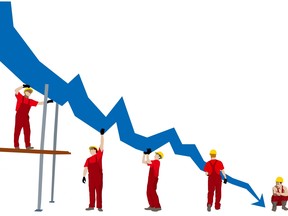
It argues that while the Justin Trudeau government was boasting about Canada’s strong economic growth during its last five years in power from 2020-2024, the average Canadian’s standard of living was plummeting by the steepest rate in any five-year period since the Great Depression.
Article content
Article content
The difference in the competing claims is the Liberal government was citing annual increases in Canada’s real (inflation-adjusted) gross domestic product — largely because of its runaway immigration policies.
Rapid and dramatic increases in population increase total GDP because more goods and services are needed to accommodate them.
But the underlying story, according to the fiscally conservative Fraser Institute, was the negative growth rate of real GDP per person, a widely accepted measure of national prosperity and standard of living.

Your Midday Sun
Article content
Advertisement 3
Article content
The study says that was adversely impacted by high immigration — because the increases surpassed the growth rate of the economy, leading to a bigger economic pie but a smaller slice for everyone, along with other government polices that led to weak business investment, including the economic uncertainty created by increased regulations, higher taxes and large deficits by federal and provincial governments.
The study — Canada’s ‘Ugly’ Growth Experience, 2020-2024: Why GDP Per Capita Declined While the Overall Economy Grew — warned Canada’s poor performance bodes ill for the future.
Study co-author Lawrence Schembri said it could mean the average Canadian’s standard of living will be even lower than a projection by the Organization for Economic Co-operation and Development that Canada will have the worst record of economic growth per person among the world’s 38 advanced economies from 2020 to 2060.
Advertisement 4
Article content
RECOMMENDED VIDEO

We apologize, but this video has failed to load.
The Fraser Institute says that while Canada’s GDP grew by an average of 1.5% annually, or 7.8% cumulatively, from 2020 to 2024, GDP per person fell by an average of 0.4% annually, or 2% cumulatively, over five years.
That was the worst record of any G7 country (Canada, U.S., U.K., France, Italy and Japan) save for Germany, the study said, and weaker than other comparable countries, such as Australia and New Zealand.
This while the Trudeau government, citing total GDP numbers, was boasting about what it said was Canada’s robust economic growth.
It’s not as if the Trudeau government didn’t know about the problem.
One of the major inhibitors of economic growth per person is a lack of productivity because of weak business investment.
Advertisement 5
Article content
Low productivity doesn’t mean workers are lazy. It means businesses aren’t investing in new technologies to increase their efficiency and productivity.
That’s in part because the Trudeau government’s runaway immigration policies gave them easy access to cheap labour as an alternative to increasing efficiency, along with the economic uncertainty created by high taxation, high debt and onerous regulations.
Prime Minister Mark Carney cited Trudeau’s high immigration policies, along with out-of-control government operational spending, as two reasons our economy was in bad shape before U.S. President Donald Trump’s tariffs.
In March 2024, Carolyn Rogers, senior deputy governor of the Bank of Canada, called low productivity a “break the glass emergency” requiring an overhaul of economic policies because the status quo was no longer an option.
Advertisement 6
Article content
Then-finance minister Chrystia Freeland described low productivity as the “Achilles heel” of the Canadian economy in her April 2022 budget speech, warning “we are falling behind when it comes to economic productivity” and “productivity matters because it is what guarantees the dream of every parent — that our children will be more prosperous than we are,” a dream dying in Canada today.
Her budget cited the OECD projection that Canada’s GDP per person from 2020 to 2060 would grow at the slowest rate among selected OECD countries and below the OECD average.
Writing in The Hub last year, University of Calgary economist Trevor Tombe said GDP per person in Canada had fallen to almost half that in the U.S., adding, “This stunning divergence is unprecedented in modern history.”
Advertisement 7
Article content
To be fair, the issue of low productivity preceded the Trudeau government and was exacerbated by the 2020 pandemic that prompted labour shortages as the economy began to recover, which was in part responsible for high immigration levels that even Trudeau, eventually, admitted were a mistake.
But Trudeau doesn’t get a pass. During the 2015 election that brought him to power, he accused then-prime minster Stephen Harper of having the worst record of economic growth of any Canadian government since the Great Depression.
A decade later, Trudeau holds that dubious title.
Read More
-

Parliamentary budget watchdog slashing its own spending by 5 per cent
-

Bank of Canada cuts key interest rate to 2.5% as U.S. tariff risks shift

Article content
