
Many critics immediately derided it as a “Russian wish-list.”
Article content
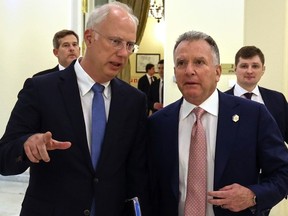
Last week, a 28-point “peace plan” for the Russia-Ukraine war surfaced. It was apparently fleshed out in Miami over cocktails by President Donald Trump’s son-in-law, Jared Kushner, Trump’s special envoy, Steve Witkoff, and Witkoff’s Russian counterpart, Kirill Dmitriev.
Advertisement 2

Article content
Many critics immediately derided it as a “Russian wish-list.”
Article content
Article content
That was before we discovered that the leaked version — probably by Dmitriev — had been literally poorly translated from Russian. In a closed-door session with senators, Secretary of State Marco Rubio even described it as a “wish-list for the Russians” and “not the administration’s plan.” On his way to Geneva for peace talks, Rubio scrambled to deny he ever said that.
But all of that is apparently moot now. What seems to have happened, amid all the chaos, is that Rubio had pried the Ukraine portfolio away from Witkoff. By Tuesday, Rubio revealed there is a whole new plan anyway.
This is good news, because the original plan wasn’t in America’s best interest.

Your Midday Sun
Article content
Advertisement 3
Article content
Many believe helping Ukraine isn’t ‘America First’
I believe American foreign policy should put America first. But I don’t subscribe to “America First” foreign policy, because that’s a label slapped on anything Trump wants, whether it’s in his personal interest or the country’s.
People who embrace the slogan “America First” generally believe that helping Ukraine isn’t in America’s interest. I think they’re wrong.
Because Russian President Vladimir Putin’s Russia is America’s enemy.
This isn’t nearly as controversial as you might think if you only get foreign policy analysis from MAGA influencers on social media. Russia allies itself with our adversaries, in China, the Americas and the Middle East. This policy is deeply rooted in Russian history and in President Putin’s nostalgia for Russian “greatness.” But if it matters, there’s also a doctrine behind it, the Primakov Doctrine, which holds that Russia should do everything it can to constrain and contain America and NATO.
Advertisement 4
Article content
RECOMMENDED VIDEO

We apologize, but this video has failed to load.
Russia has been mucking about in the internal affairs of the U.S. and its allies for nearly a century. In recent years, it has allegedly tampered with electricity grids, elections and cyber systems. It funded psyop campaigns — using useful idiot influencers and willing volunteers alike — to pump racism, antisemitism and sinister conspiracy theories into domestic politics here and abroad.
“The Russian Federation is the most significant and direct threat to Allies’ security and to peace and stability in the Euro-Atlantic area,” according to NATO.
Russians are the bad guys
If you’re of a more idealistic bent, Russia is also a murderous authoritarian regime that oppresses its own people and visits heinous war crimes on its neighbours.
Advertisement 5
Article content
America shouldn’t be helping Russia
That’s why there’s a compelling moral argument for helping Ukraine resist a lawless and brutal invasion that has taken perhaps a million lives and resulted in the kidnapping of tens of thousands of Ukrainian children to be brainwashed. Our national honour is on the line as well, given that America encouraged Ukraine to give up its nuclear weapons in exchange for “security assurances” in the 1994 Budapest Memorandum. Legally, assurances aren’t “guarantees,” but they’re not nothing either.
Put morality and national honour aside. A cold-eyed, America-First strategist might argue that the slaughter of Ukrainian troops — and civilians — is in our interest if it comes at the cost of bleeding Russia’s military, economy and global prestige.
Advertisement 6
Article content
No, we shouldn’t send American troops to fight Russia. That is a strawman raised by opponents of helping Ukraine at all.
But weapons? Intelligence? Why not? Many of NATO’s weapons were built for the purpose of fighting Russia. If Ukraine can use them to that end, it’s the best of both worlds. This leaves out that we can — and do — sell many of these weapons, either to Ukraine or our European allies, who then transfer them.
And it’s been working. Russia didn’t have the bandwidth to save its puppet regime in Syria. It didn’t — couldn’t — ride to the rescue of Iran, Hamas or Hezbollah either. The Russian economy is a mess, with near double-digit inflation despite insanely high interest rates.
And yet, this original “peace deal” would rescue Russia, ceding it territory — including all of the Donbas — that it hasn’t been able to win militarily. It would provide Russia with sanctions relief, invite it back into the G8 and hobble Ukraine militarily and politically. It describes America as a “mediator” between Russia and NATO, even though NATO is an alliance created and led by America. There is no greater strategic goal for Russia than dividing America from its NATO allies. All of this in exchange for the “expectation” that Russia wouldn’t invade Ukraine again later.
Hopefully, Rubio has come up with something more in America’s interest and less in Russia’s.
Article content
