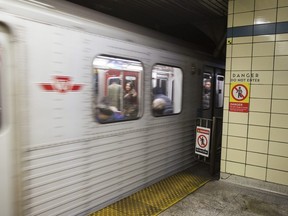
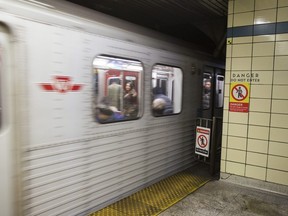
London’s underground dwarfs Toronto’s subway system, but crime is nowhere near the issue it is on TTC system
Article content
LONDON — This city’s subway system — the Underground or the Tube, they variously call it — is simply enormous. Millions of people use it every day.
Advertisement 2

Article content
In all, it is 400 km in length — 10 times the length of the City of Toronto, essentially, from east to west. It serves nearly 300 stations, across more than a dozen lines — while Toronto has four, connecting with just 75 or so stations.
Article content
Article content
London’s underground dwarfs Toronto’s subway system. Depending on how you measure it, it is 400% to 500% bigger.
And in all of 2025 so far for every million rides taken on London’s Underground? There were just 20.7 crimes committed. The majority of them are thefts and “anti-social behaviour.”
Reported crimes have surged on TTC system
Toronto? Between 2016 and 2024, the number of crimes happening on Toronto’s transit system — serious crimes like attempted murders and extreme violence and sexual assaults — surged by more than 160%. In Toronto, a person is taken into custody under the Mental Health Act once every four times a TTC constable reports to work to patrol the subway system, a July Toronto Sun analysis found.

Your Midday Sun
Article content
Advertisement 3
Article content
As our Justin Holmes reported on 1,150 incidents in just a few months in 2020: “(The events in the TTC database include) petty crime and individual instances of aggravated assault, attempted murder, robbery.”
Added Holmes: “At St. George Station on Dec. 14, 2023, a person was said to have been apprehended three times under the Mental Health Act in a span of 24 hours, twice by TTC constables and once by Toronto cops. Meanwhile, on April 18 at Dundas Station, a person was seen smoking a cigarette in the tunnel. ‘Victim mentioned being suicidal and the hospital keeps releasing them,’ the entry says.”
In multiple cases, Holmes noted, there are repeated references to narcotics use — and several entries “contain the words ‘urine’ or ‘urinate,’” he wrote. The crimes happened at every single Toronto subway station. Since the pandemic, too, the crime numbers in Toronto have gotten dramatically worse.
Advertisement 4
Article content
Transit safety ‘major issue’ in Toronto: Bradford
Toronto councillor Brad Bradford — who, full disclosure, this writer will be supporting if he is on next year’s mayoral ballot — is one of the few municipal politicians addressing the issue. “Transit safety is a major issue in Toronto,” said Bradford. “Riders deserve real protection — and enforcement that will actually keep them safe.”
Toronto is not alone. Transit-related violent crime has exploded across Canada. Between 2015 and 2024, violent crime has nearly tripled in Winnipeg and more than doubled in Edmonton, Montreal, Kitchener-Waterloo and Toronto.
So how does London do it? How can a system that dwarfs any transit system in Canada do so much better?
Advertisement 5
Article content
If one uses the Underground, as this writer has many times in the past few days, some of the reasons become evident. For starters, the London Underground has an extensive closed-circuit television system — there seems to be hardly an inch of public space that is not monitored.
RECOMMENDED VIDEO

We apologize, but this video has failed to load.
‘Help points,’ police assistance readily available in London
In addition, Transport for London and the British Transport Police are seen virtually everywhere, as are regular transit staff — and commuter-assistance “help points,” some 500 of them, are found throughout the Underground. Travellers need only push a button to get connected instantly to a staff person or a central control room.
There are crowd-management people at busy times. There are anti-suicide measures in effect everywhere. And throughout the day, commuters are urged to report any suspicious activity, ranging from petty crime to terrorism. “See it, say it, sort it,” announcers chime on public address systems, while providing a text number to do so.
Advertisement 6
Article content
Across the British capital’s system, that is what one sees everywhere: People connected to the internet on their devices. Some still are old-fashioned and read books, but most are online — which likely serves to deter plenty of would-be criminals.
“The biggest crime here is phone thefts,” said one former Calgarian who has lived in London for years. “Mainly teenagers.”
Courtesy, efficiency part of London system’s charm
Toronto and other cities have many of the anti-crime measures described above. So why does London do so much better by virtually every measure?
Throughout London’s Underground, visitors are struck by how courteous and efficient the whole system seems to be: There’s tended plants at the Embankment at High Street Kensington Station, requests that travellers “please” hold hand rails and stay to the right on escalators, announcers apologizing for the rain causing some surfaces to be slippery and signage politely cautioning against staff abuse, sexual harassment and hate crimes — all “have consequences,” the signs note.
The people using London’s Underground seem to be uniformly decent. Few panhandlers, for example, are to be seen — and when they were present outside a Tube entrance, someone was talking to them to offer them something to eat or simply say “good luck.”
London’s transit system is better than our systems in Canada because everyone here has seemingly made a decision to treat everyone else with this:
Civility.
Read More
-

LILLEY: Crosstown unlikely to open this year, probably will in January
-

Man charged after sex assault on GO train; firearms seized in gun probe
Article content
